
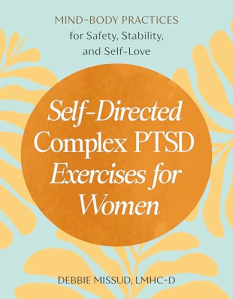
SELF-DIRECTED COMPLEX PTSD EXERCISES FOR WOMEN by Debbie Missud
Nonfiction, Self-Help, Psychology, @Zeitgeistpublishing, @penguinrandomhouse
4****
Blurb: Regulate your emotions, find safety in relationships, and live the fullest version of your life. Your trauma is not your fault. But managing its symptoms is something within your control. Complex PTSD (cPTSD) refers to the aftermath of ongoing or repeated trauma—often relational—that impacts a person’s life. Self-Directed Complex PTSD Exercises for Women is a compassionate, self-guided workbook that offers trauma-informed tools for being able to safely inhabit your body, reengage in relationships, and step into a full-color version of your life. Drawing from psychological training, holistic research, and direct clinical experience, it includes practices for nervous system regulation, mind-body integration, and self-understanding. Here, you’ll find:
- 50+ self-led exercises inspired by proven trauma-informed modalities—somatic practices, EMDR, IFS, DBT, attachment-based, and narrative therapy—to help you reconnect with your body, emotions, and inner wisdom.
- Fast-working tools to move beyond fight, flight, freeze, or shutdown—helping you find stability, safety, and joy in everyday life.
- A practical road map to identify your values, nurture self-compassion, and align with the truest version of yourself.
- Compassionate guidance from holistic psychotherapist Debbie Missud, LMHC-D, who specializes in complex PTSD support for women, bridging the gap between clinical knowledge and everyday healing.
Created by and for women, this book is for those seeking peace, connection, and trust from the inside out. Feeling better—grounded, whole, and free—is possible. And the fact you are here means it is within reach.
THOUGHTS: “Healing doesn’t mean forgetting the past or never being triggered again.” I liked how this book started with an introduction to PTSD and an explanation of the different types of modalities including EMDR, IFS, DBT and more. Once you get past the introduction, you are into the exercises – and they are broad in range so if one style doesn’t work for you, another might. They can seem repetitive, but therapy is often like that. Not all the exercises will appeal to everyone, but you are welcome to pick and choose what best works for you. There are sixty exercises in all, so you’re sure to find something that fits. At the end, there are several pages of resources including podcasts, books, websites, online communities, apps and support lines. The author also stresses that if you are in danger to yourself or others, to seek professional help.
Disclosure of Material: I received a final and/or advanced reader copy of this book with the hope that I will leave my unbiased opinion. I was not required to leave a review, positive or otherwise, and my opinions are just that… My Opinions. I am posting this in accordance with the Federal Trade Commission’s 16 CFR, Part 255: “Guides Concerning the Use of Endorsements and Testimonials in Advertising” Thanks to Zeitgeist and PenguinRandomHouse for providing this ARC.
 Sparkling Book Reviews