Birthdays: Richard Henry Dana, Jr. (1815), Herman Melville (1819), Paul Horgan (1903), Stanley Middleton (1919), Robert Waller (1939), David Gemmell (1948), Amy Friedman (1952), James Gleick (1954), Madison Smartt Bell (1957), James St. James.
Richard Dana, Jr. is best known for his memoir “Two Years Before the Mast”
Herman Melville is best known for his masterpiece “Moby Dick”
Paul Horgan won two Pulitzer Prizes in History.
Stanley Middleton won the 1974 Booker Prize for his novel “Holiday”
Rober Waller is best known for his 1992 novel “The Bridges of Madison County”
James Gleick has been a Pulitzer and Nat’l Book Award finalist multiple times.
Quote: “It’s easy to lose the energy that you need for a long piece unless the characters are surprising you and showing you something new every week, or even every month, or every other paragraph – however often it comes.” – Anne McDermott
Tip: This is national eye exam month. A writer’s eyes are almost as important as his imagination. When was the last time you had a good eye exam? If you can’t remember, schedule one.
Jumpstart: August is the only month without any sort of recognized holiday. You have been tasked with creating one. What or who will it honor? Why? Will it be national or international? Will workers get the day off?
Birthdays: Brett Halliday (1904), Primo Levi (1919), Lynne Reid Banks (1929), Cees Nooteboom (1933), Susan Cheever (1943), Faye Kellerman (1952), Steven Womack (1952), Lynne Rae Perkins (1956), J.K. Rowling (1965),
Primo Levi was an Italian chemist and writer. His “If This Is a Man” is an account of his time in a Nazi concentration camp, and his “The Periodic Table” was named the greatest science book ever written by the Royal Institute of Great Britain.
Lynn Reid Banks is best known for her children’s book “The Indian in the Cupboard”.
Lynn Perkins book “Criss Cross” won the 2006 Newbery Medal.
J.K. Rowling is best known for her “Harry Potter” series.
Tip: Thinking about your writing career and where it currently is. Are you happy with it and where you’re headed? If not, what can you do to change things? Remember, you can only adjust things you are in control of.
Jumpstart: You’ve just inherited a piece of land from a relative you never knew about. It turns out to be a junkyard. But one that specializes in a particular type of “junk” – each piece is haunted. What do you do?
Birthdays: Emily Brontë (1818), Dominique Lapierre (1931), Patrick Modiano (1945), Archer Mayor (1950), Marcus Pfister (1960), Cherie Priest (1975)
Patrick Modiano won the 2014 Nobel Prize in Literature.
Quote: ““Writing is a strange and solitary activity. There are dispiriting times when you start working on the first few pages of a novel. Every day, you have the feeling you are on the wrong track. This creates a strong urge to go back and follow a different path. It is important not to give in to this urge, but to keep going. It is a little like driving a car at night, in winter, on ice, with zero visibility. You have no choice, you cannot go into reverse, you must keep going forward while telling yourself that all will be well when the road becomes more stable and the fog lifts.” ― Patrick Modiano
Tip: Even though it’s difficult or hurts, reading over rejections a second (or third) time can show you where you might have some weaknesses you need to work on. Especially if multiple editors are saying the same thing.
Jumpstart: You’re walking down the street, window shopping, when you hear a scream from an alley up ahead. You have no phone. What if it’s late night and you’re alone? What do you do?
Birthdays: Alexis de Tocqueville (1805), Booth Tarkington (1869), Eyvind Johnson (1900), Stanley Kunitz (1905), Sam Sinclair Baker (1909), Chester Himes (1909), Edwin O’Connor (1918), Sharon Creech (1945), Kathleen Krull (1952), Didier Van Cauwelaert (1960), Chang-rae Lee (1965), Adele Griffin (1970), Wil Wheaton (1972)
Eyvind Johnson shared the 1957 Nobel Prize for Literature with Harry Martinson.
Stanley Kunitz was the winner of the 1955 National Book Award for Poetry and the US Poet Laureate in both 1974 and 2000.
Edwin O’Connor won the 1962 Pulitzer Prize for Fiction for “The Edge of Sadness”
Sharon Creech won the Newbery Medal for “Walk Two Moons”
Quote: “I love the way that each book—any book—is its own journey. You open it, and off you go….” ― Sharon Creech
Tip: When thinking about marketing, think outside the box. Write a book about a pet shop? Try selling your books there. A hair salon figure in your story? Ask them if they’d sell some books for you. Be creative, but don’t be a pest. If you’ve never gone into a particular bookstore or shop, don’t expect them to be open to selling your books for you.
Jumpstart: There was an accident at a science lab you were visiting and you’ve been shifted into a different phase. You can see and hear everyone, but no one can see or hear you. What do you do? Remember, being out of phase with this reality means no food or other comforts for you.
Birthdays: Gerard Manley Hopkins (1844), Beatrix Potter (1866), Malcolm Lowry (1909), Malcolm Lowry (1909), John Ashbery (1927), Shirley Ann Grau (1929), Natalie Babbitt (1932), Jim Davis (1945), Robert Aspirin (1946), John Feinstein (1956), William T. Vollman (1959), Jon J. Muth (1960), Michael Ruhlman (1963)
Beatrix Potter is best known for her children’s stories like “The Tale of Peter Rabbit”
John Ashbery won the 1976 Pulitzer for his poetry collection “Self-Portrait in a Convex Mirror”
Natalie Babbitt’s books “Tuck Everlasting” and “The Eyes of the Amaryllis” were both made into movies.
Jim Davis is best known for his “Garfield” comics.
Quote: “There is something delicious about writing the first words of a story. You never quite know where they’ll take you.” ― Beatrix Potter
Tip: If you can get into a good critique group, do so. They are invaluable. Not only will they help you with your writing, but in critiquing their work, you might learn a lot too. Just be aware, it make take several tries to find a good fit for you.
Jumpstart: Write up a zodiac profile of your main character. Is she a Leo, or a Scorpio? Or use the Chinese years – was she born in the year of the Dog or the Bull?
Birthdays: Alexandre Dumas (1824), Giosue Carducci (1835), Hilaire Belloc (1870), Elizabeth Hardwick (1916), Jack Higgins (1929), Paul B Janeczko (1945), Robert Rankin (1949), Kate Elliott (1958), Cassandra Clare (1973)
Alexandre Dumas (fils) is the son of the French author of the same name. His novel “La Dame aux Camelias” was adapted by Verdi into the opera “La Traviata”
Giosue Carducci, an Italian poet, was the winner of the 1906 Nobel Prize in Literature
Quote: “The greatest gift is the passion for reading. It is cheap, it consoles, it distracts, it excites, it gives you knowledge of the world and experience of a wide kind. It is a moral illumination.” ― Elizabeth Hardwick
Tip: If you get a rejection letter that has suggestions in it, really look at it. The agent or editor took valuable time to write that to you so pay attention. Most rejections are form letters, when they even come. Having an editor respond personally to you is important.
Jumpstart: You’re hosting a dinner for a large group of people—two from each country of the world. What do you serve? What do you talk about? How do you seat them?
Take in the wild beauty of Santa Catalina Island with tour guide and eclectic gift shop owner Whitney Dagner. On the itinerary: dramatic Pacific coastlines, diverse marine life, and murder! Since returning home from mainland California and finding her groove with the family tourism business, Whitney Dagner’s daily routine has become a wonderfully chaotic adventure. She and her nimble kitty, Whiskers, often find themselves at the center of the action on Catalina, from staged treasure hunts to gossipy birdwatchers. But before Whit can get too comfortable in the place where she grew up, a gift shop order leads to a stunning discovery—someone’s dead body . . . One of Whit’s best boat tour client’s, Leo Franklin was young and newly engaged when he unceremoniously took his own life. Only it doesn’t seem like that’s what really happened—not after the suspicious activity displayed by his family’s old rivals at the scene of his death. As a bitter, generations-long feud between Leo’s kin and the local Ahern clan comes to a head, Whit and her police diver not-so-ex-boyfriend must lead a dangerous investigation into years of scandal and bad blood to figure out who’s innocent . . . and who’s covering a killer’s tracks.
After writing plays for her friends to act out as a kid, bad poetry in high school, and her high school Alma Mater song, Gabby Allan finally found her true passion—cozy mysteries. Being able to share her world with readers, one laugh at a time, and touch people’s hearts with her down-to-earth characters makes for the best job ever. This California girl now lives with her husband in Central Pennsylvania where she is hard at work on her next novel.
Tricia needs to liquidate assets to keep her late grandmother’s orchard out of foreclosure, but Travis—the guy who stood her up on prom night years ago—claims he had a handshake deal with Nana to buy the crop duster.
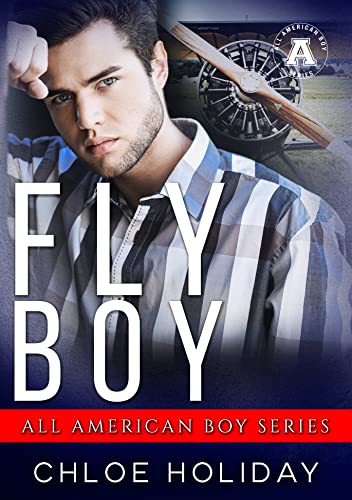
Travis burned her once, but now Tricia must choose: Flame him, or forgive and forget? Maybe he’s changed. But … what if the rumors are true? Photographer Tricia Carlisle inherits her beloved grandmother’s orchard and leaves Chicago for her Texas roots, steeling herself to be immune to the charms of the small town—and those of Travis Walker, who stood her up on prom night seven years ago. Worse, she arrives only to find Nana’s place is in foreclosure. To have any hope of saving it, Tricia has no choice but to sell down assets—including her grandfather’s crop duster. Travis Walker loses his last true friend when Nana Carlisle passes. Will his handshake deal to buy her crop duster survive now that Tricia is taking over? She’s cash-strapped and probably still hates his guts. He needs that plane—it’s his ticket out of this small town that sees him as a crook—but it’s on Tricia’s radar now. Fly Boy is a steamy, stand-alone second-chance novella in the All-American Boy Series. It’s set in Deacon, Texas—home to sexy country boys and sassy, tough women. Warm, lazy afternoons in a hammock and swimming holes in a shady creek. Hot, heavenly Tex-Mex and even hotter kisses. Come on down, y’all!
About Chloe:
Chloe writes steamy, fun novels about ordinary people in extraordinary circumstances, smart women and men who aren’t jerks. Her stories feature friendships—close women or a good bromance—with all the feels: the thrill of a smoldering gaze or the barest brush of fingertips, the shocked gasp at the underhanded villain, the angst of heartbreak, the joy of reunion, and of course, happily ever after! She enjoys humor and embarrassing situations as well as a vicarious sneak peek into intriguing groups (military personnel, medicine, another culture like Greece, sailing, diving, or rock climbing…) A little danger is always fun, so many contain a suspense subplot. She hates to read the same old thing, with only the names and places changed, so her goal is to bring you a fresh, fun, new story every time, with NO CLIFFHANGERS: a rollicking, great escape that whisks readers away and love prevails.
Birthdays: Alexandre Dumas (1802), Henrik Pontoppidan (1857), Percy FitzPatrick (1862), Lord Dunsany (1878), Edward Plunkett (1878), Junichiro Tanizaki (1886), Robert Graves (1895), Zelda Fitzgerald (1900), John D. MacDonald (1916), Aaron Elkins (1935), Albert Marrin (1936), Barry N. Maltzberg (1939), Arliss Ryan (1950), Brad Watson (1955), Banana Yoshimoto (1964), Madeline Miller (1978),
Henrik Pontoppidan was the co-winner of the 1917 Nobel Prize in Literature.
Quote: “As an author, one of the most important things I think you can do once you’ve written a novel is step back. When the book is out, it belongs to the readers and you can’t stand there breathing over their shoulders.” – Madeline Miller
Tip: Establish POV (point of view – the person who is telling that part of the story) often. Readers put books down or are reading other things while reading yours. They tend to stop at chapter breaks so be sure to establish POV at the next scene or chapter break.
Jumpstart: Write a scene where you’re a much older—and wiser—version of yourself. What advice would you give your younger self?
Birthdays: Raymond Chandler (1888), Elspeth Huxley (1907), Hubert, Jr. Selby (1928), John Nichols (1940), Lisa Alther (1944), Gardner Dozois (1947), Vikram Chandra (1961), Mohsin Hamid (1971), Lauren Groff (1978),
Quote: “I wrote for fourteen years and couldn’t get published. So I got used to the idea of not having an audience. I knew that if I were going to continue writing, I had to find other reasons than fame and riches and reactions from readers. I decided that I love to write, that it’s the most fun I have, so that makes it worth doing; and I use writing to figure out things about my life and the world, so that makes it worth doing; and it’s a craft and I can feel that I’m getting better at it and thus may hope eventually to get published, and that makes it worth doing.” – Lisa Alther
Tip: Edit your short story as if every word costs you ten dollars. How much fluff do you have?
Jumpstart: How would your main character tell a good friend about his/her current circumstances? What about after a few drinks? Describe the conversation and where it takes place.




 Sparkling Book Reviews